
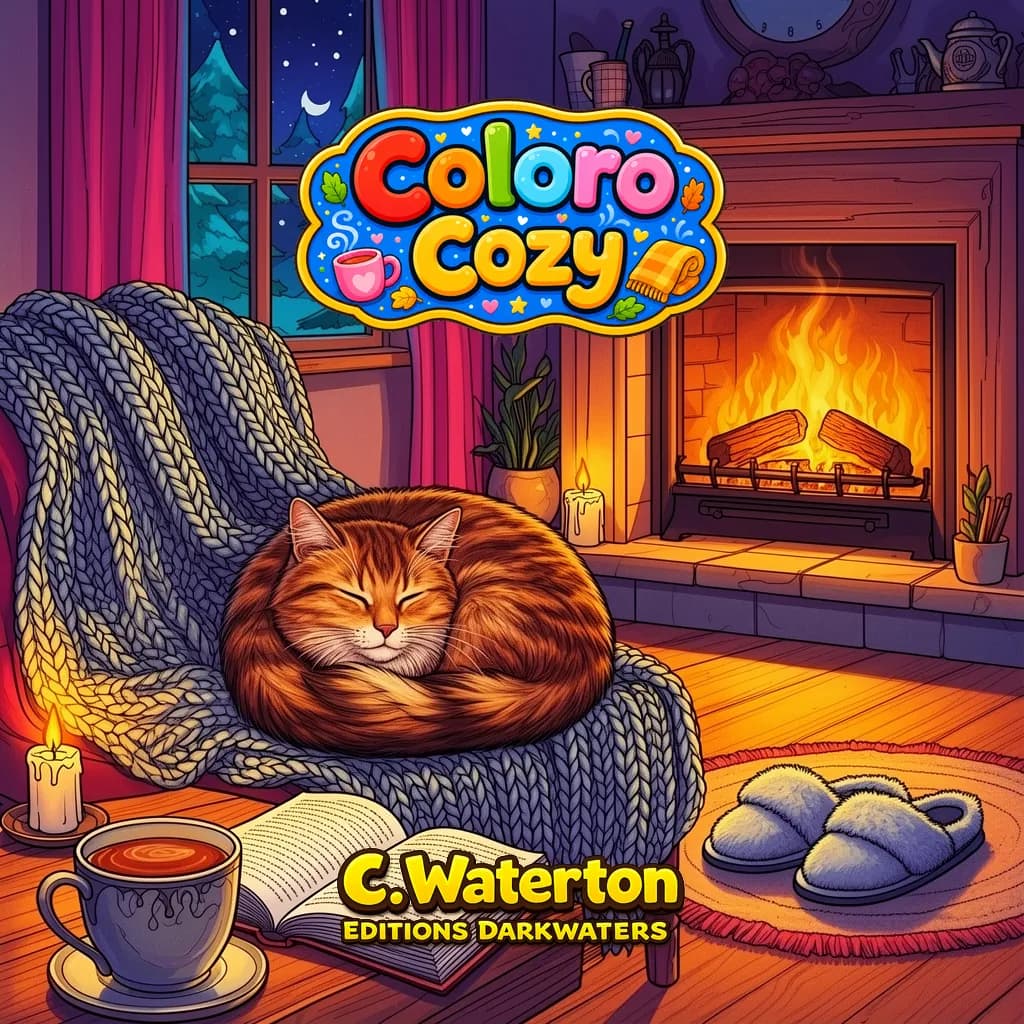
- Stress-relieving activity, in the hygge and cocooning spirit.
- Gentle motifs: tea, blankets, candles, warm interiors, snuggled animals.
- Soothes children and adults at the end of the day.
- Encourages mindfulness and relaxation.
- Fine motor skills for children, a quiet moment for adults.
What is cosy coloring?
Cosy coloring features everything that suggests softness and comfort: a steaming cup of tea, a blanket, a candle, an animal curled up by the fire. It is the hygge spirit - the well-being of small simple moments - translated onto paper. It is colored slowly, for pleasure rather than performance. In practice: choose this theme for a moment of relaxation, with no aim of achieving a result.
Does coloring really help you relax?
Yes, and it is proven. Several clinical trials reviewed by the NIH show that coloring a structured design significantly reduces anxiety and increases mindfulness. By focusing on the outlines and the colors, you switch off from stressful thoughts: coloring becomes a simple, accessible moment of refocusing. In practice: offer a cosy coloring page in the evening to help children and adults unwind.
When should you offer a cosy coloring moment?
Cosy coloring fits naturally into quiet moments: after school, on a rainy Sunday, before bedtime. It is also a lovely activity to share as a family, each person on their own page, in the soothing silence of the living room. Unlike an energizing activity, it prepares you for rest. In practice: reserve it for calm transitions: the end of the day, coming home from school, the run-up to bedtime.
| Moment | Pourquoi le coloriage cozy y convient | Bénéfice |
|---|---|---|
| Après l'école | Transition vers le calme | Décompression |
| Dimanche pluvieux | Activité douce à la maison | Moment partagé |
| Avant le coucher | Rituel apaisant | Endormissement plus serein |
How can you create a cosy atmosphere for coloring?
Soft lighting, a hot drink, a blanket, calm music - and well-sharpened pencils within easy reach. The atmosphere matters as much as the activity. For more gentle breaks, browse our soft animal coloring pages or the full collection. In practice: pay attention to the atmosphere (lighting, hot drink, silence): it provides half the benefit.
Is cosy coloring suitable for adults too?
Absolutely. Adult anti-stress coloring is based on exactly this principle: gentle, structured motifs that calm the mind. As a family, everyone colors their page in the quiet of the living room, at their own pace. It is a rare moment when children and adults do the same activity, without screens or competition. In practice: set aside a shared coloring session on Sunday: each person with their own page, in peace.
What materials should you use for a cosy atmosphere?
Choose pencils in soft shades - beige, terracotta, sage green, powder blue - which reinforce the calming feel. Slightly thicker paper holds the color well and can be kept as a comforting object. A warm light and a drink within reach complete the ritual. In practice: favor soft shades and thick paper: the finished object adds to the comfort.
What mistakes should you avoid for a relaxing moment?
- Chasing performance: pleasure comes before the result.
- Coloring in noise or in a hurry, which breaks the calming effect.
- Offering a design that is too busy and becomes a source of stress.
- Limiting the activity to children: adults benefit too.
Does cosy coloring help you sleep better?
It helps. Built into the bedtime routine, a gentle coloring session marks the transition between the day's hustle and the calm of sleep. By slowing the hand and focusing attention on the colors, it soothes body and mind - a bit like a story being read aloud. It is not a sleeping pill, but a clear signal: rest is approaching. In practice: include a short cosy coloring session in the evening routine, before the story and bedtime.
What is cosy coloring?
A coloring activity with soft, warm motifs (tea, blankets, cocooning), in the hygge spirit, done to relax.
Does coloring help you de-stress?
Yes: clinical trials show that it reduces anxiety and increases mindfulness.
Is cosy coloring only for adults?
No: it is also suitable for children from age 3, with simpler motifs.
When should you offer cosy coloring?
During quiet moments: after school, in the evening before bedtime, or on a rainy Sunday.
How can you make the moment more calming?
Take care over the atmosphere: soft lighting, a hot drink, calm music and well-sharpened pencils.
Which cosy motifs are most popular?
Tea cups, blankets, candles, warm interiors and snuggled animals come up most often.
Can you enjoy cosy coloring at any age?
Yes: both children and adults find it relaxing, with motifs adapted to each.